Monday, October 31, 2011

Another Writer Connects to New York City

 As a writer, what city could be more inspiring and intimidating to live in than New York?  Googling "famous New York City writers," my intimidation takes on a face, or many faces, as I read through even a partial list. . .

Noel Coward
Eugene O'Neill
Jack Kerouac
E. B. White
Willa Cather
E E Cummings
Allen Ginsburg
Arther Miller
Edna St. Vincent Millay
Edgar Allen Poe (who knew??)

Some of them came and went, some came and stayed, but each shared a unique connection to this city.

Barely surviving in cold water flats with square footage so minuscule it could scarcely be measured, hands freezing in threadbare gloves, shoulders hunched over a borrowed typewriter or pencil and legal pad, these writers sacrificed all for their craft.  Their lines of genius, just waiting to be discovered!

Highly romanticized, melodramatic and stereotypical, I grant you, but with enough grains of truth to inspire this writer, and thousands of others, to open their laptops or sharpen their pencils each day.

Yet, what is it about this city that fuels my own passion to write, encourages me to take risks, grow, learn, to become a better writer?  Having lived here only 2 months, I'm still early in the discovery process, but two critical areas have already surfaced.  

 Other writers. . .

     Stepping yards beyond my writing comfort zone, I began a 4-week Poetry Workshop last week through The Sackett Street Writers in Brooklyn.

Sackett Street where the writing group began in 2002

My first writing group!  Five writers gather around a table sharing our work. I hear comments from others which I've expressed many times myself, always in isolation.
"This is hard!"
"I've revised this so many times, I've lost the feeling I started out with."
"Yes! finally after 3 hours, I found the exact word that works in this line."  (Only other writers can get excited about such things.)

I feel a huge sense of relief to be among fellow writers, knowing that for two hours on Monday evenings, I can open the door of my solitary writing room and mingle with people who speak the same language.  It's like being invited to a party.

We read poetry by writers I've heard of, like Mary Oliver, and others I haven't like, William Heyen.
We're encouraged to write styles of poetry we've never tried.
We learn how to "read with a writer's perspective."
We grow.  

New sights. . .

Obvious, yes, but beyond the obvious.


A single tree on a gently sloping hill in Central Park caught my attention last week as I wandered, without direction or intention.  I sat under its yellowing leaves, ate my peanut butter and jelly sandwich and wrote a poem.

Opportunities for writing in New York City proclaim themselves as loudly as the Empire State Building and as shyly as the tree.  The exhilaration comes in never knowing what will speak to my soul, challenge me to put what I see and feel into words.  The next sight might be a homeless man asleep by the entrance to Dunkin' Doughnuts, Van Gogh's "Irises" on the wall of the Metropolitan Museum of Art, a freak October snowstorm, or. . . .

 The city will provide what I need.  My job is to make the connections, 
in the rich tradition of countless writers before me, 
and keep sharpening those pencils.      


Monday, October 24, 2011

A Day -- Out of the City

One of the great things about living in New York City is how quickly you can get out of it. (Perhaps I should qualify that with. . . on a Saturday at 6:30 a.m. on the subway/train.)  I timed our exit this weekend as we left for a day in Connecticut:

3   minutes - walk to subway
5   minutes - wait for #4 express
7   minutes - Brooklyn Bridge/City Hall station to Grand Central Terminal
5_ minutes - purchase tickets, walk to train platform
20  minutes TOTAL from apartment door to Metro-North train door!

As the sun was leisurely pulling itself out of bed on the first day of a weekend, our train cleared the terminal.  I opened a book; Drew leaned back for a snooze.  Two-and-half hours later we would be in Waterbury, where our friends, Marian and Jim, would pick us up.  With no responsibility but to ride, read and look out the window, I settled into my seat with a relaxing sigh.

About forty-five minutes outside Waterbury, the passing scenes began to change.  Reds, oranges, and yellows yelled for our attention as the sun spotlighted the brilliance of the season. With my camera pressed to the window, I snapped picture after picture.  The blending of colors, created by the  movement of the train, reminded me of a delicate impressionistic painting.


One group of particularly bold branches stretched their leafy limbs precariously close to the track so we could fully appreciate their beauty.


Nature surrounded us all day as we ate lunch in Marian and Jim's tree-lined backyard, hiked 3 miles in Flanders Nature Center, and reminisced over scrapbook pages at the kitchen table (while nosey shrubs peeked through windows.)  Jim's father, whose wife recently died, joined us in the sunshine.

Photos from our walk, combined with the simplicity of a poem*, speak to me of a day that was truly a gift.


 scent of pine

 trickle of water

warmth of sunshine

 on an upturned face  

heal

refresh

celebrate


We returned to the city as quickly as we left, but this time. . . I forgot to look at my watch.  

*©2011 Twylla Alexander
   

Monday, October 17, 2011

9/11 Memorial . . . and More

Ground Zero is a five-minute walk from our apartment building.  I pass the construction site or look up at Freedom Tower (One World Trade Center) every day.


Blue, heavy mesh plastic covers the chain-link fencing that surrounds the multi-block work zone, restricting the view of the 9/11 Memorial inside.  I have read descriptions and seen glimpses of it on t.v. during the 10th anniversary ceremonies, but still can't imagine the layout, the positioning of the pools, the trees, the grass-covered areas.

Thanks to a neighbor who told us about the availability of same-day tickets at the NYC Information Kiosk - City Hall, we pick up our passes for the 2:00 o'clock time slot on Saturday afternoon.  After a 15-minute wait in line and comprehensive security check reminiscent of an airport screening, we follow the wall of blue to the Memorial.  Openness greets us, as if the surrounding buildings have taken several steps backward.  Yet the enormity of the space tells a truer story of what happened, the terror that created the vacuum.

The air immediately feels different.  Cooler, wetter, like walking into woods after a rain.  I take a deep breath; my body relaxes.  Sounds of the street disappear.  Falling water absorbs the extraneous, the unnecessary, as if cleansing the space, leaving room only for the essential.


White oak trees, row after row, newly planted, offer shelter, comfort.   Stripes of manicured grass and evergreen ivy soften the well-worn soil, sooth anxieties. Birds explore a new neighborhood, singing of their excitement.

I'm unprepared for the enormity of the pools, marking the foundations of the original towers and the depth of loss.  The void creates unease, makes me want to move away; yet the soothing waterfalls encourage me to stay.


My fingertips move from letter to letter,  feeling the names carved through the thick bronze panels surrounding the pools.  Names of the victims demand that we stop, feel, remember.


A place of destruction has become "a place of refuge and safety," a sanctuary for all who visit.

Grateful to live in the neighborhood,  I will return often to receive its peacefulness.  Yet, I walk away knowing that the Memorial requires something of me, as well. . . to live her peace, to pass it on.      


Friday, October 7, 2011

Lives Touched by Apples

I had scheduled a One-to-One appointment to learn how to use my new MacBook Air at the Soho Apple store for Wednesday morning at 9:00.  About 12 hours earlier, the rest of the world, and I, learned that Steve Jobs had died.  We were just beginning to realize what we had lost.

A pot of bright yellow chrysanthemums, sitting on the sidewalk against a storefront, caught my eye as I turned off Broadway and walked towards the corner of Prince and Mercer.  Mourners and well-wishers had already begun their tributes beside the Apple store's tall glass doors.


Walking under the simple black logo,
I opened the door and went it.


It was quiet. Of course, it was still early morning; many shops in the area had not yet opened. Delivery trucks, pulled up to curbs, were off-loading bagels in boxes and clothes on racks, while street vendors spread today's specials across tables. About 20 customers were browsing at iPads, iPhones, iPods, iEverything downstairs, with close to an equal number at the Genius Bar and personal training tables upstairs.


Blue-shirted Apple specialists, who eagerly stepped forward to offer assistance in my previous visits, stood in pairs and trios - somber, subdued - talking softly among themselves, shock still fresh on their faces.


I met my personal trainer, and we sat down at the corner of a large blonde, wooden table, surrounded by other couples of teachers and learners.  As I turned on my computer and clicked on Safari, it automatically opened to Apple's website displaying the pensive picture of Steve Jobs (photo no longer shown; replaced by written tributes), accompanied solely by the dates, 1955-2011.  My companion said, "You know, he made computers fun.  Not just numbers and algorithms.  He made them fun for everyone - pictures, videos, phones -- fun!" I listened as he went on, "You think about the world and all its problems, the economic crisis, wars, but when you think of Apple, don't you think about peace?  It's a peaceful thing, all he created." Shaking his head to re-focus, he apologized for his philosophizing and started our lesson.

My mind was only half-way concentrating on the wonders of the MacBook Air, while the rest of it was pondering the influence one life can have on so many others.  This twenty-something young man, so intently helping me understand the beauty of my new computer, had profoundly been touched by Steve Jobs, a man whose life work has permeated the way all of us live our lives.

The flowers, candles, pictures and personal notes had grown during my hour in the store.  As I exited, I noticed one sign, in particular, which spoke to the legacy Steve Jobs leaves to countless generations, who will never know what the world was like before his genius.


Monday, October 3, 2011

Freedom to Speak

I was walking home along Church Street in Lower Manhattan, past Liberty Plaza Park (Zuccotti Park) where the Occupy Wall Street protesters were settling down to another night of encampment, past St. Paul's Chapel where George Washington prayed after delivering his first inaugural address, and past Ground Zero, where Freedom Tower (One World Trade Center) was standing watch over the city.


I stopped to gaze up at the tower, look behind me at St. Paul's historic facade, then mentally re-trace my steps a couple of blocks to the protesters. The symbolism surrounding me sank in, one puzzle piece at at time, as if the shapes were appearing from the drizzly mist . . . Liberty Park, Occupy Wall Street, George Washington, Freedom Tower.

Prior to that moment, I had given the protesters little thought.  News reports explaining their cause, along with vague images of cardboard placards, paraded past my attention with a slew of other headlines.  Perhaps this is because my understanding of economics and the debt crisis would fit comfortably on the surface of a penny.  Mention the Federal Reserve, and my eyes glaze over.  But it was their right to protest which I more fully began to appreciate that evening.

Never having been a protester myself and wanting to feel what it's like to be among a few hundred, I walked back to Liberty Park the next day.  Needless to say my grandmotherly white hair didn't fit in with the predominantly 20 and 30-year olds , but I was cordially invited to "come in, walk around, ask questions."  I was surprised to see organization --


sign-making station,


                                      food co-op                                                                                                                          


library
                                                                       technology area


-- calmly held conversations,
communities bordered by sleeping bags, backpacks, and belongings.


People free to assemble, peacefully,
to speak, openly,
in opposition to their government.


This freedom was not part of the U. S. Constitution when it was signed in 1787;  it was added as the first amendment in the Bill of Rights, ratified 4 years later.  Freedom of speech, press, religion and petition.  Amendments advocated by George Washington  in his first inaugural speech at Federal Hall - today's address, 26 Wall Street.

Washington on the steps of Federal Hall

Whether or not I agree with, or even understand, the issues that the Occupy Wall Streeters are challenging, I must recognize their right to do so. Michael Douglas, through the writing of Aaron Sorkin, passionately espouses this philosophy in one of my favorite films, The American President:

"America isn't easy.  America is advanced citizenship.  You've gotta want it bad, 'cause it's gonna put up a fight.  It's gonna say, "You want free speech?  Let's see you acknowledge a man whose words make your blood boil, who's standing center stage and advocating at the top of his lungs that which you spend a lifetime opposing at the top of yours."

A protester's sign says it even better. . .


Sunday, September 25, 2011

A New York Public Library Card!

"The library was a little old shabby place.  Francie thought it was beautiful.  The feeling she had about it was as good as the feeling she had about church.  She pushed open the door and went in.  She liked the combined smell of worn leather bindings, library paste and freshly inked stamping pads better than she liked the smell of burning incense at high mass."
--A Tree Grows in Brooklyn, by Betty Smith

When I walked in the front door of my "growing-up library" in Arkadelphia, Arkansas, I felt much the same as Francie. There was nothing shabby about it, with it's polished hardwood floors, matching paneled walls and sparkling floor-to ceiling windows, but it was the feel. . . the feel of the place that remains with me almost 50 years later. There was a reverence about it, a calmness and respect, something reassuring like sitting beside my grandmother in "our" pew on Sunday mornings.

I wasn't the reader at 11 that Francie was.  "She had been reading a book a day for a long time now and she was still in the B's."  For me, the joy was more in the looking, examining the covers, thumbing through the pages -- feeling the books in my hands.  Should I pick the one with the palomino horse looking ever-so grand, the best friends walking arm in arm, or another Nancy Drew, the one that sounded particularly scary?  And I loved to check-out, putting that carefully chosen book on the librarian's desk, handing her my library card!  It was light blue, the corners wrinkled and worn, with my name at the bottom, written in perfect fifth-grade cursive.

From then until now, one of the first things I do when we move to a new (English-speaking) place, is get a library card. But in New York City, with 43 neighborhood branches in Manhattan alone, where should  I go?  The obvious choice is the New Amsterdam branch, just 2 blocks from our apartment, but I want an adventure; I want to go to the BIG, main, flagship library, the one with the lions guarding the entrance.  So, undaunted by drizzle, I take the #4 Express to 42nd street, walk 2 blocks to 5th, and there it is.  What would Francie think?


White marble, grand staircases,  gold-lettered inscriptions on the walls, candelabras highlighting names of wealthy benefactors. Nothing shabby here.


With application and ID in hand, I climb the two flights to room 315, the main reading room of the Research Library, where the library card application desk is located. The magnificence of a museum greets me, with muraled art covering the door ways and ceiling.
(photo by Wikipedia)
A simple sign, "Apply for a Library Card Here," directs me to a row of arched, wood-framed windows, which looked like they have been transported from a fancy 1920s bank lobby.

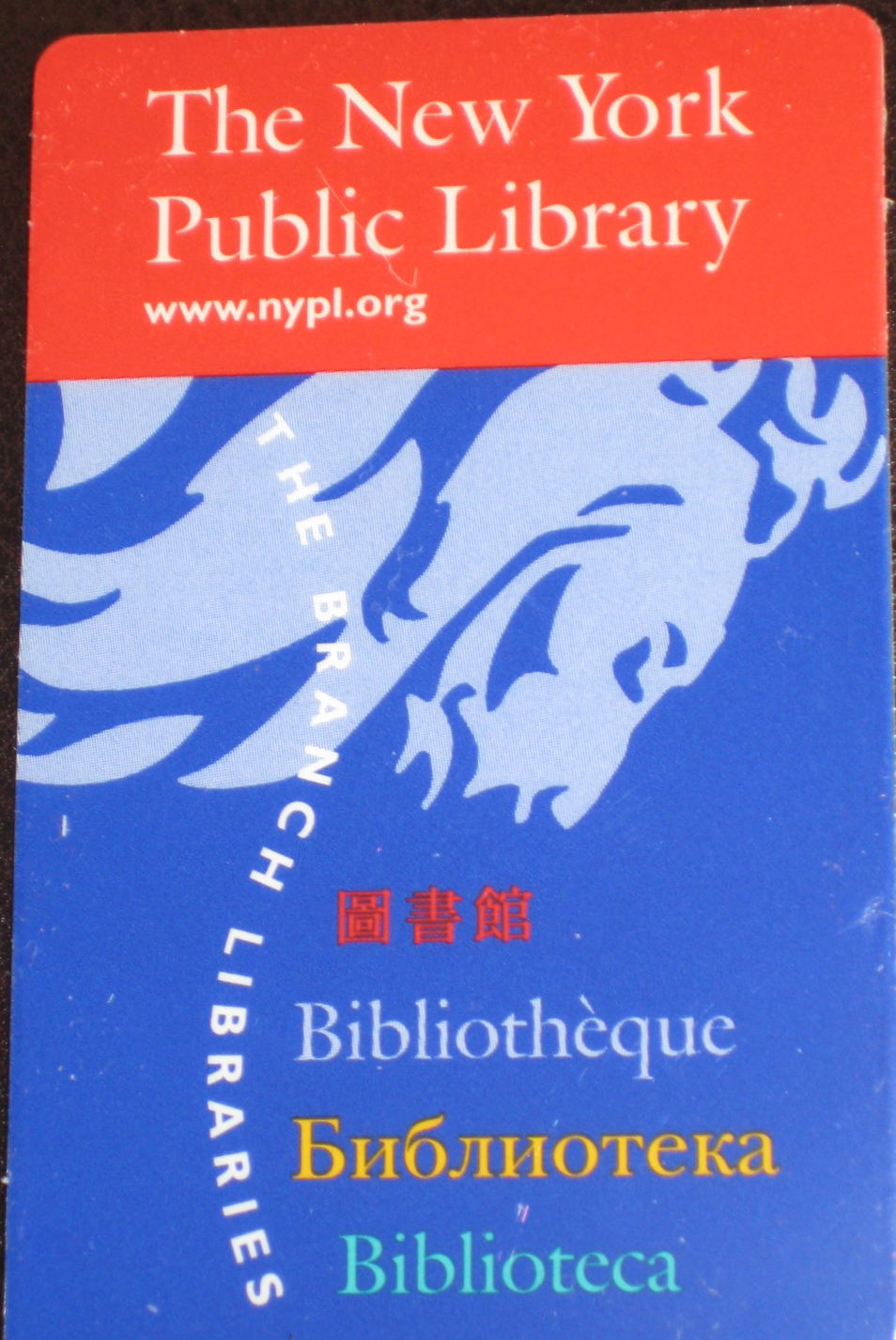
The "teller" (aka librarian) enters my information into the computer, checks my ID, then presents me with a shiny, blue NY Public Library card!


Of course, I have to use it today, to experience the joy of feeling a borrowed book in my hands, one that has been read by others, and is waiting patiently on the shelf to visit my home.  Since the main library is for research rather than lending (except the children's section), I walk across the street to the Mid-Manhattan branch, check the catalog and find what I'm looking for, thankfully, with "available" by the title.
Proudly handing the librarian my card, the book is mine, until October 14.

A Tree Grows in Brooklyn.  My third time to read it.  Francie and I will, again, spend hours together, "at peace with the world and happy as only a little girl can be with a fine book and a little bowl of candy. . ."

What is your library story?  Please share it for others to enjoy.


Monday, September 19, 2011

Curious George in Manhattan (but leaving soon!)

 "This is George."

(Disney clipart)
"He was a good little monkey and always very curious." 

So begins each new adventure of Curious George, the series of books which children have been snuggling up to at bedtime and circling up to at storytime for over sixty years.  My brother and I were two of those children, encouraged by our mother, a kindergarten teacher, whose collection of yellow-covered Curious George books took up an entire section of her overflowing bookshelf.

The family tradition continued last week when 2-year-old granddaughter, Ruby, came for a visit, bringing along Mama and Papa.  She had studied the guidebooks, checked the internet and knew exactly what she wanted to do in "The Big City."  Right at the top of her list was the Children's Museum of Manhattan where George was hanging out in the "Curious George, Let's Get Curious!" exhibit. Thanks to Mama and Papa's love of reading, Ruby knows all about George's exploits at the library, baseball game, hospital and camping.   As she dashed from bigger-than-life George to his friend, The Man in the Yellow Hat, and everything in between, I discovered the quietest area in the room, where few of the pre-school crowd was gathered. . . filled with facts about George's creators, H. A. and Margret Rey.


The splashy yellow and red sign, with squiggly edges and trademark Curious George signature, provided no clues about the seriousness of Hans and Margret's own daring adventure.


Escaping Paris only hours before Nazi troops entered the city, the pair left by bicycle, pedaling for three days, spending one night in a cow stable before reaching a train station.  Speeding across Spain to Portugal, they boarded a boat in Lisbon that took them to Brazil, where they booked passage on another boat headed for. . .


They had no room for luggage, for a carry-on stuffed to over-flowing, no place to put possessions except in a bicycle basket. Perhaps they hurriedly threw in a change of clothes, a prized family photograph, a loaf of bread.  The one item we know of, for sure, that they tucked safely inside Hans' coat, was the manuscript for George (originally named "Fifi").  As a writer, I completely understand this.  It was their creation, built from hours and hours of thought, imagination, collaboration --  selecting just the right words, penning just the right expressions. An artist's work becomes part of who he or she is.  It was not a choice for them to leave it behind.

And for generations of readers, what would childhood be without the curiosity of a little monkey to entertain and make us laugh?  The exhibit moves on after September 25th, but thanks to Margret and Hans, we have George forever.
George and Ruby


Web Analytics